Much like other kitchen and bath product categories, cabinets and storage needs are always progressing and developing. At KBIS 2026 in February, we saw innovations like upper cabinet lifts, state-of-the-art wine storage, colorful hardware, durable materials for the indoors and out and LED-lit shelves and toe kicks. Accessibility, personalization and customization are top wish-list items for today’s kitchens and baths, and cabinetry plays a huge role in providing these elements.
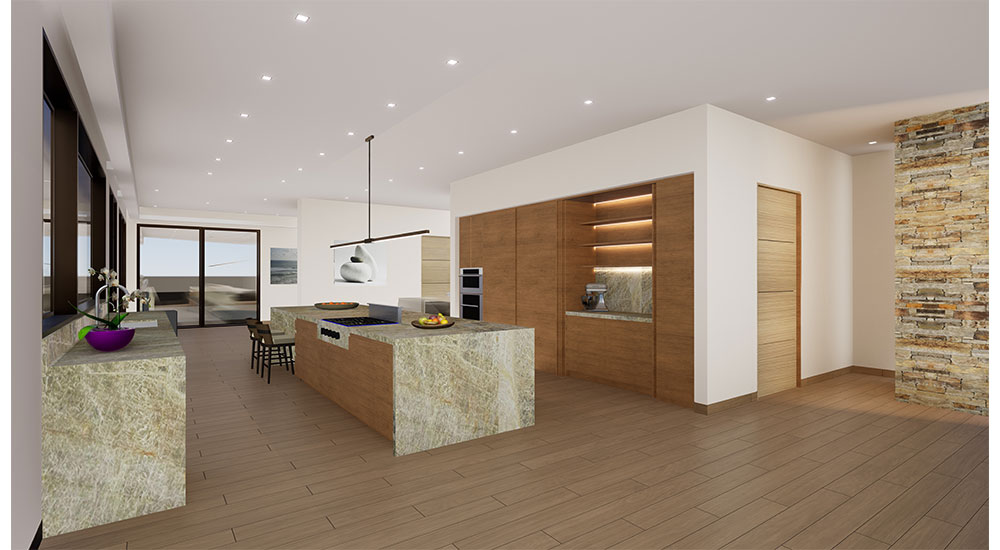
Above photo: This kitchen rendering by Jennifer Osborne of Lori Carroll & Associates reflects a thoughtfully layered approach to cabinetry, where multiple finishes are used to create depth, balance and quiet contrast. A concealed countertop section behind custom cabinetry doors allows small appliances to be tucked away with ease. The cabinetry incorporates low- or no-VOC finishes and formaldehyde-free construction, aligning the design with a more mindful approach to indoor air quality and long-term sustainability.
In our most recent survey, we polled industry experts on popular cabinet finishes, the rise in two-tone designs, sustainable and eco-friendly features, concealed storage options and the inclusion of interior integrated cabinet lighting. We also asked about specific customization options for kitchen and bath cabinets and storage, recently discovered cabinetry innovations and most significant challenges faced when procuring cabinetry for clients.
Finish Fashions
For bathroom cabinetry, light natural woods came in at the top of the list (63.1%), with warm wood tones coming in at a close second with 61/9%. Painted neutrals (50%) and matte finishes (28.6%) came in third and fourth places, and finishing up the list were deep, saturated colors; tow-tone cabinetry; dark, wood tones; and high-gloss finishes. Other answers included black tones, soft blues and greens and three-tone cabinets.

“Alongside the classics, we’re also seeing clients gravitate toward more unexpected finishes, such as aged painted woods and heavily textured surfaces that add depth and character to the space,” said designer Lori Carroll of Lori Carroll & Associates in Tucson, Ariz.
In the kitchen, warm wood tones came in first place as the most coveted cabinetry finish with 65.9%. Light, natural woods (63.5%); painted neutrals (53.3%) and two-tone cabinetry (44.3) came in the second through fourth most popular finishes. Rounding out the list were matte finishes; deep, saturated colors; dark wood tones; and high-gloss finishes. Other choices were glazed finishes; light, saturated paints; colored glass; and three-tone cabinets.
Using more than one finish for kitchen and bathroom cabinets is growing in popularity – for both homeowners and designers. Almost 50% of our survey respondents said they do this frequently or always in their clients’ kitchens and baths.
“I have been incorporating three finishes in spaces for years,” said Brooke Eversoll, CMKBD, founder and CEO of Bee Studios Inc. in St. Petersburg, Fla. “This is more visually interesting and helps create places for your eye to rest and also move around the space.”
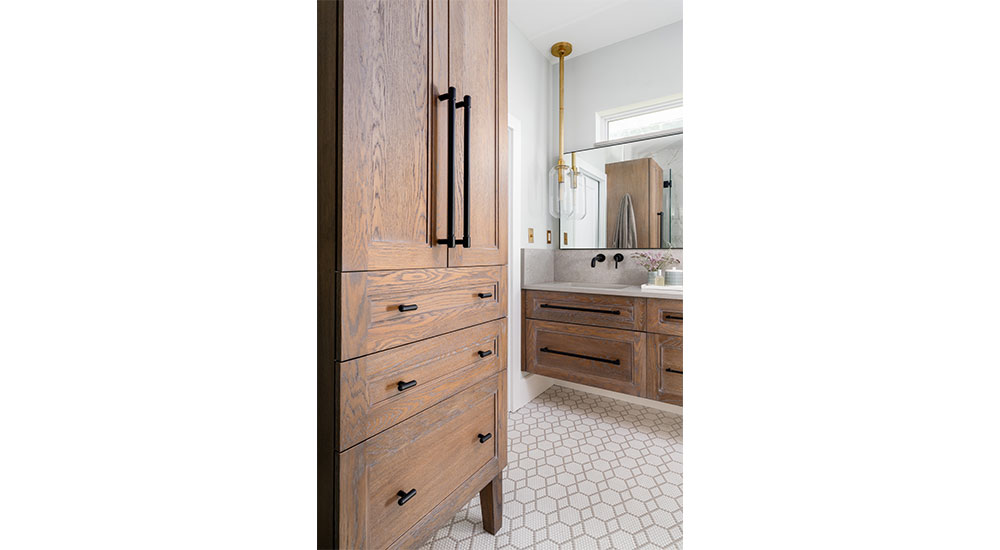
Using Bremtown Cabinetry’s customization, designer Brooke Eversoll and her team were able to achieve the illusion of more space in this bathroom. The vanities were installed 12 inches off the floor, and the linen cabinet was elevated on 8-inch legs. For storage, the cabinet drawers were notched for sink plumbing, and rollouts were used for makeup organization. Photo credit: Chris Restrepo, Penlight Media
Sustainable Selections
Being eco-friendly with kitchen and bath selections is gaining in popularity, and the most coveted feature regarding cabinetry is to specify durable choices that offer long-life construction (68.7%). Specifying cabinets that are made with low-VOC finishes (41.7%), those that are manufactured locally (39.9%) and those that are crafted with formaldehyde-free adhesives (31.3%) also made the list of sustainable options.
“Additionally, we’re seeing a growing emphasis on certified materials, including those aligned with DECLARE and LEED standards,” said Carroll. “These considerations are quickly becoming less of an upgrade and more of an expectation.”
Rounding out the choices were KCMA-certified cabinets, FSC-certified wood and recycled/recyclable materials. Other answers were all-wood construction, refacing cabinets instead of replacing them and Architectural Institute-certified cabinets.
Hidden Solutions
In terms of concealed storage options for today’s kitchen cabinetry, the most coveted choice is pull-outs (87.3%), followed closely by pantries (82.5%). Blind corners (58.4%), appliances garages (53.6%) and rotating shelving units (49.4%) came in second through fourth. Toe kick drawers, larders, pie-cut corners, two-tiered drawers and built-in paper towel holders were additional hidden storage choices.
We also always incorporate a double trash pullout, and our standard is to use the metal tracks/frames – never a trash can set in a wood cutout,” said Eversoll. “This is the dirtiest area of the kitchen and needs to be fully cleanable.”
Only 41% of our respondents said they incorporate interior lighting into their cabinet designs always or frequently. Carroll says it is an element she and her team actively incorporate into their projects.
“It not only enhances functionality, thus making it easier to navigate storage, but also elevates the overall aesthetic of the space,” she added. “Lighting within cabinetry, drawers and specialty areas like appliance garages creates a layered, intentional design that feels both practical and refined.”
Prioritizing Personalization
According to our survey, the demand for custom versus semi-custom cabinetry in the kitchen and bath has largely stayed the same over the last 12 months. Just under 14% said it has increased substantially.
The main reason clients may not be asking for as much customization inside cabinets is cost. Some homeowners choose to incorporate these elements after the kitchen or bath project is complete.
According to one respondent, “It comes down to being intentional during the design phase. I’ve found that when I take the time upfront to really think through how a client lives and uses their space, I can design cabinetry that fully supports those routines. If those decisions are deferred with the idea that ‘we’ll figure it out later,’ it almost never happens – and the cabinetry ends up being more generic than it should be.”
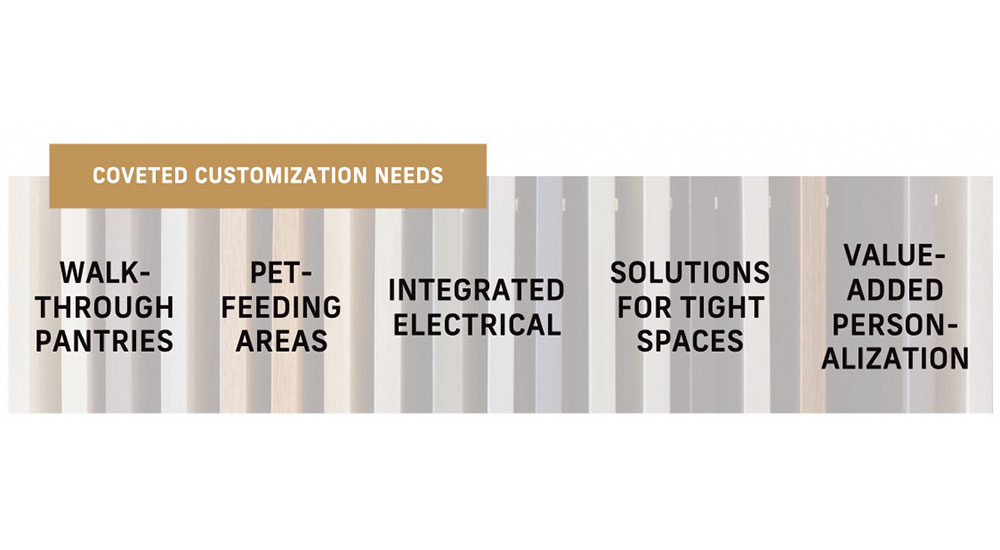
Homeowners who seek out customization within their cabinets do so for added convenience, accessibility, function and less clutter in their spaces. One respondent says they treat every cabinet as having a responsibility, whether it’s storage, task-driven function or organization.
“Even when specific customization is not initially requested, we often guide clients toward solutions that improve usability,” said Carroll. “Features such as in-drawer power, integrated lighting, storage dividers and tailored inserts allow us to create spaces that are not only beautiful but highly personalized. The range of options available today makes it possible to truly design cabinetry around each client’s lifestyle.”
Sourcing Challenges
The most significant hurdles around procuring cabinetry in today’s projects include lead-time delays, shipping and fuel costs, availability of replacement parts or specific wood species, damaged units and tariffs, which can result in custom fees for imports. One respondent said they struggle with balancing increased demand for customization with an unpredictable supply chain – especially for specialty and globally sourced materials.
According to Carroll, one of the most significant challenges in procuring cabinetry is labor, saying that securing skilled teams can be difficult. She also claims that installation is another critical piece, and finding the right crews who can execute at a high level and within project timelines continues to be a challenge across the industry.
“If there are known or potential sourcing concerns, we address them early – either by securing key items during the conceptual phase when availability aligns or by flagging them and monitoring restocks as the design develops,” said one respondent. “This allows us to stay ahead of potential delays rather than reacting to them late in the process. If, by the tail end of the design phase, certain items are still unavailable, I’m prepared to pivot. That might mean introducing alternative materials, adjusting details or reworking specific elements to maintain the integrity of the overall design.”
According to Eversoll, the hardest part about procuring cabinets is less about supply chain and more about length of time for the build until they need the cabinets.” It’s often a juggling game of determining when to place orders so the cabinets have minimal time in storage and can go directly to site for installation. Our area was hit hard by the 2024 hurricanes, so juggling a build schedule and product timing is always a challenge.”
Cabinetry Innovations Discovered at KBIS 2026
Some of these discovered by the KBB editors were noted at the beginning of this article, and our respondents had some great feedback as well. At KBIS earlier this year, a lot of the innovations involved the inside of cabinets with an increase in interior finishes, integrated charging and lighting and personalized storage.
Specific storage solutions noted were automated, pull-down spice racks; wall cabinets that lift up and down; unique lift hinges; modular organization; blind corner cabinet inserts; and solid-wood drawer inserts. When it came to cabinet hardware, our respondents noted seamless integration and jewel-like designs.
Carroll noted the use of alternative and mixed materials, such as leather-wrapped finishes, which bring a unique tactile quality to cabinetry and expand the design possibilities beyond traditional wood applications. Eversoll saw metal trims used to enhance cabinet fronts, which she says her team has been incorporating in custom applications, but it was great to see a source with a more readily available and pre-fab option.