ADA and senior-residence accessible bathroom product categories have historically received limited attention in design conversations. In recent years, however, perceptions around these fixtures have begun to shift. What was once associated with purely institutional aesthetics has evolved into a new generation of products that combine accessibility, safety and contemporary design. This transformation is evident across the bathroom and shower environment, from lavatory faucets to integrated shower components.
Rethinking the Grab Bar
The traditional grab bar, once reminiscent of what you might find in a fast-food restroom stall, has been redesigned with more refined curves, improved anchoring systems and expanded functionality. Rather than appearing as a separate, utilitarian fixture within the shower, modern grab bars are often integrated with handshower holders or slider mechanisms. The result closely resembles the appearance of a contemporary handshower slider rail.
These integrated systems allow the handshower to be adjusted easily to accommodate users of varying heights while maintaining the textured finishes required for improved grip. At the same time, they continue to meet the structural requirement of supporting up to 250 pounds. The slider components, which also function as the handshower holder, typically incorporate a larger lever. This design makes them easier for users with limited strength or dexterity to manipulate and lock into place.
Prioritizing Temperature Control and Safety
Temperature control and safety are equally important considerations. Depending on local regulations, pressure balance valves are often required. In other jurisdictions, a thermostatic valve may be the minimum requirement, and in some cases, regulations require a combined pressure-balanced and thermostatic valve system. Each of these technologies provides anti-scald protection and improved temperature stability during shower use.

For example, a sudden drop in cold water pressure will not expose the user to dangerously hot water. The internal safety mechanisms, whether a cartridge balancing spool or a thermostatic element, automatically adjust the outlet temperature to remain within a few degrees of the temperature originally set by the user. It is also advisable to verify whether the selected valve or cartridge includes a temperature adjustment device. This feature allows installers to set a limit on the amount of hot water that can be mixed with cold water within the valve. By restricting the handle’s rotation range, the maximum water temperature can be kept within both the user’s comfort level and the limits required by local codes.
Flexible Valve Solutions for Modern Projects
Bélanger offers several valve configuration options to address these requirements. This is particularly evident with the 100VSR series valves, which are compatible with both pressure-balanced (P) cartridges and combined pressure-balanced and thermostatic (TP) cartridges. The same interchangeability between P and TP cartridges is also available within the 300VSR series valves, which additionally support interchangeable two-way and three-way diverters.
Because cartridges and diverters are supplied with the trim kit rather than the rough-in valve, the valve body can be installed first during construction. The final control configuration can then be selected later with the trim package, providing additional flexibility during project planning.
User-Friendly Controls and ADA Compliance
While the internal components manage temperature control and safety, the exterior trim defines the overall user experience within the shower environment. Lever handles on the primary mixer and diverter controls allow for straightforward operation while remaining within the 22.2-Newton maximum activation force required to open, close and adjust water flow under ADA guidelines.
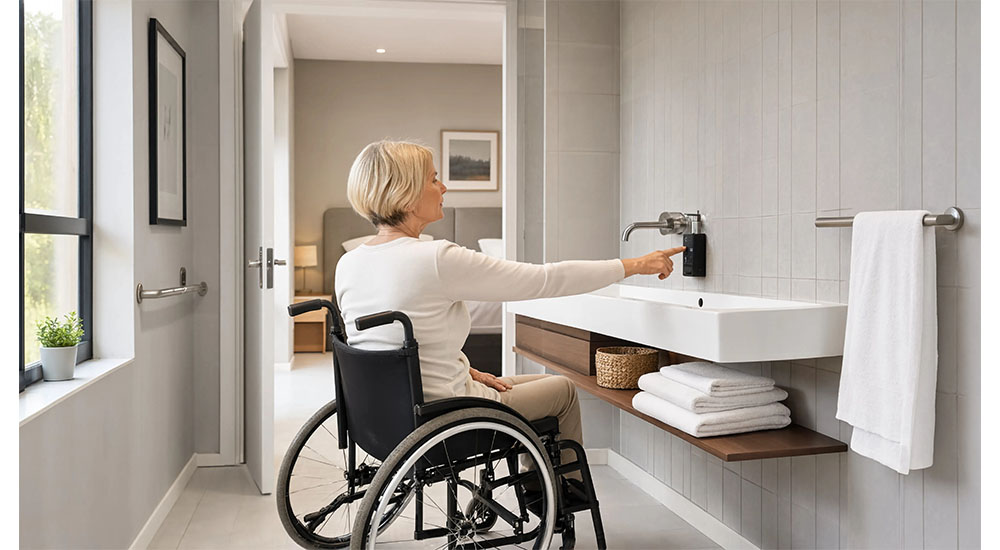
Across the broader bathroom environment, this same activation force requirement applies to lavatory faucets, whether they are single-hole models, 4-inch centersets, or 8-inch widespread configurations.
Expanding Design Possibilities for the Accessible Bathroom
In more recent designs, the faucet industry has also introduced push-button ON/OFF activation systems. Similar to the push-button ignition systems that became common in the automotive industry, these controls provide a modern aesthetic while maintaining ADA compliance and ease of use.
Push-button configurations also offer practical advantages. Users can easily activate or stop specific shower functions without needing to readjust temperature settings. In some cases, users pause the water flow while soaping, which contributes to reduced water consumption.
The industry continues to evolve and is steadily moving toward accessible bathroom solutions that accommodate a wider range of users without compromising design, comfort or safety.
—Karel Lysy is product engineering manager at Bélanger