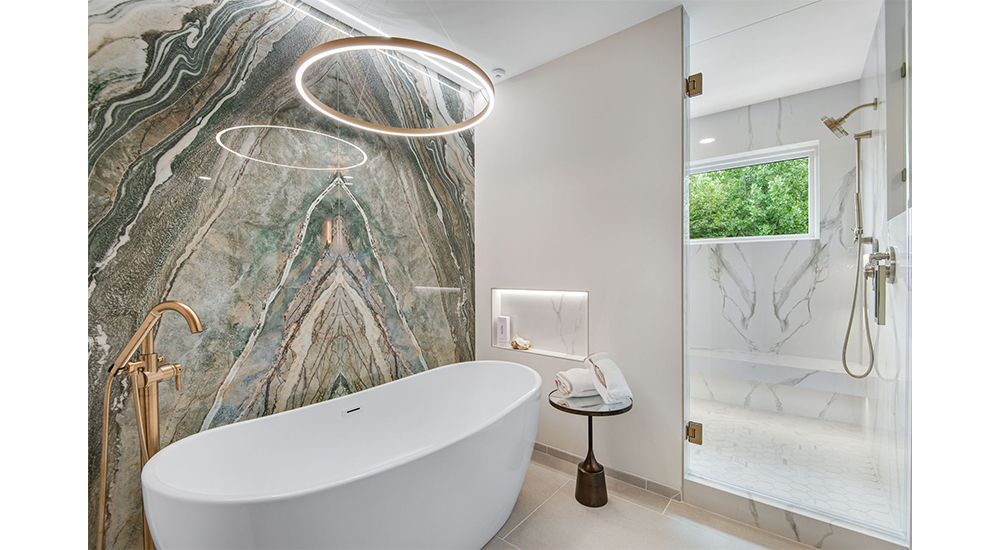
Homeowners are rethinking two of the bathroom’s biggest fixtures, favoring larger, more accessible showers and softer, more sculptural tubs. The 2026 U.S. Houzz Bathroom Trends Study from Houzz, the AI-powered software platform for home construction and design, digs into the styles, materials and features shaping these renovations, revealing how showers and bathtubs are evolving to support both everyday routines and long-term comfort.
Most Upgraded Showers Are Growing in Size
More than half of renovating homeowners who upgrade their shower (58%) increase its size. Most expand their shower by less than a quarter (23%), while increases of a quarter to a half rose 5 percentage points to 19%, and 16% of homeowners increased their shower by more than half. A smaller share of renovating homeowners keep their shower at its original size (down 5 percentage points to 41%). Just 2% end up with a smaller shower.
Low-Curb Showers Remain the Top Style Choice
When upgrading showers, homeowners most often choose low-curb designs (47%), while curbless showers rose 4 percentage points to 24%. Alcove designs remain popular too (41%), as do corner showers, which rose 6 percentage points to 24%. Dual showers account for more than 1 in 5 upgraded showers (21%). Shower-over-tub combinations fell 7 percentage points to 5%, making it the least widespread style by a clear margin.
Hinged, Frameless Glass Doors Are the Clear Favorite
Doors remain a near-universal shower feature, with 85% of renovating homeowners installing them in their showers. Hinged doors have become the standard for shower entries, chosen by 51% of renovating homeowners, up 12 percentage points year over year. Sliding doors fell 6 points to 14%, and curtains declined 5 points to 8%, while fixed panels held steady at 7%. Among shower doors, frameless designs grew in popularity, rising 4 percentage points to 80%. The semiframed style accounts for 14% of upgraded showers, and fully framed for 6%.

Porcelain and Ceramic Tile Cover Most Shower Floors
Tile is the overwhelming choice for shower flooring (79%). Natural pebble stones follow at a significant distance (15%), while slab accounts for 6% and wood for less than 1%. Within floor tile, porcelain is the top material (42%), with ceramic close behind (35%). Natural stone and engineered surfaces are far less widespread. Marble appears on 11% of upgraded shower floors, acrylic in 3%, and limestone and engineered quartz in 2% each. By shape, hexagonal leads shower floor tiles (26%), followed closely by rectangular, which fell 4 percentage points to 25%, and square at 21%. Round (8%), octagonal (4%), diamond (2%) and oval (1%) tile trail well behind.
Horizontal Patterns Dominate Shower Walls
Horizontal brick is the most widespread shower wall tile pattern, chosen by 27% of homeowners, with vertical stack close behind at 25%. Horizontal stack follows at 15% and vertical brick at 11%. Decorative patterns appear on a small but significant share of upgraded shower walls, led by mosaic at 3%, while herringbone and chevron each appear on 2% of shower walls, and crosshatch, arabesque and checkerboard each account for 1%.
To Keep the Tub or Replace it
When renovating a bathroom, 38% of homeowners upgrade the bathtub and another 8% keep their existing tub. In more than a quarter of projects (26%), a bathtub is removed, while 27% of renovating homeowners had no tub in the first place and didn’t add one. When a tub comes out, 79% of renovating homeowners use the space to enlarge the shower, and 24% relocate it. Storage claimed more of that freed-up space this year, too: Enlarging cabinetry rose 5 percentage points to 14%, and enlarging the vanity or sink rose 5 points to 11%. A smaller share of homeowners move a vanity or sink (7%) or relocate cabinetry (5%), while enlarging and relocating closets round out the list at 3% each.
Freestanding, Soaking Tubs Are Having a Moment
Among homeowners adding or replacing a tub, more than half (57%) now choose freestanding flat-bottom bathtubs, an increase of 12 percentage points year over year. Alcove tubs fell 18 percentage points to 22%, while deck-mounted tubs rose 7 points to 13%, nearly doubling their share. Freestanding claw-foot (5%) and corner-style (1%) tubs remain the least popular options. By type, soaking tubs are now the most widespread choice in renovated bathrooms (72%, up 10 percentage points year over year), while standard tubs lost share, falling 10 percentage points to 19%. Walk-in tubs remain rare at 2%. Acrylic still leads bathtub materials by a wide margin (54%), with fiberglass a distant second (12%). Enameled cast iron and cast polymer tie at 9% each, with ceramic close behind at 8%.
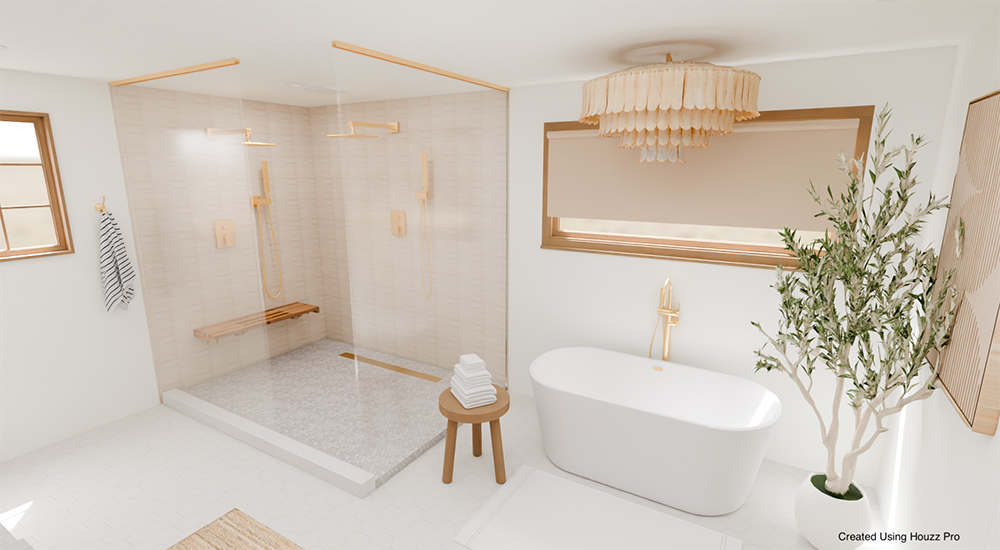
This 3D render was created using Houzz Pro to showcase key trends from the 2026 U.S. Houzz Bathroom Trends Study; Credit: Houzz Pro
Specialty Tub Features Pull Back, but Nonslip Flooring Leads
Fewer than half of renovating homeowners include specialty features in their new or upgraded bathtub (46%), down 9 percentage points. Grab bars also declined, installed by 14% of homeowners and down 8 percentage points, followed by nonslip flooring (23%) and space for two (13%). Whirlpool or jet options round out the list at 9%, while a seat, built-in lighting and a heated backrest each appear in 5% of new or upgraded tubs.
For more shower and bathtub statistics, along with data on vanities, colors, lighting and sustainability, check out the complete 2026 U.S. Houzz Bathroom Trends Study.
*The 2026 U.S. Houzz Bathroom Trends Study is a report of homeowners who are in the midst of, are planning or recently completed a bathroom renovation. The online survey was fielded to U.S. Houzz users in August 2026 (n=1,619).