
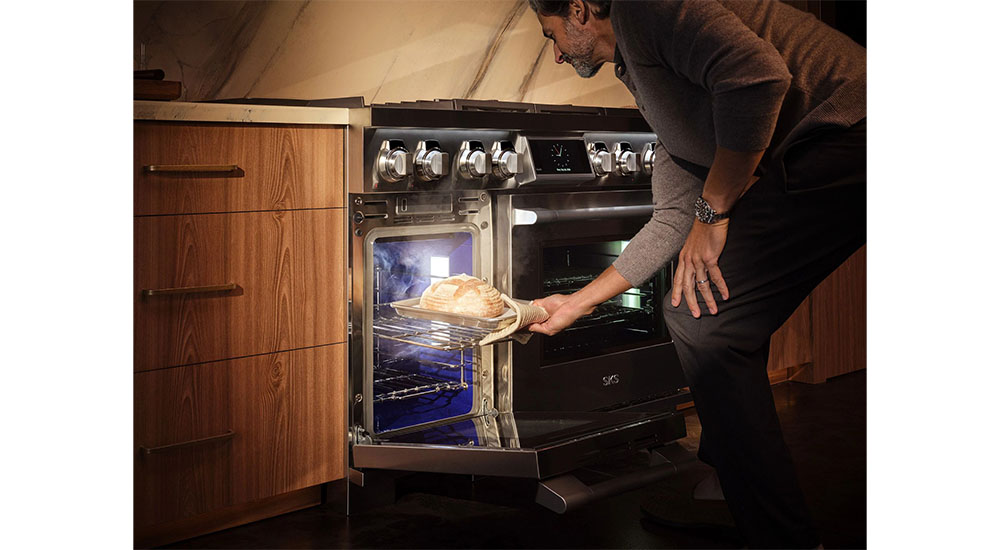
The custom kitchen has quietly become one of the most sophisticated rooms in the modern home, and the shift has far more to do than just cabinetry and finishes.
In fact, it’s appliance technology that is increasingly dictating layout and the overall design language of today’s kitchen spaces. As professional-grade cooking appliances with features like built-in sous vide precision and intelligent connectivity move from novelty to expectation, builders and designers are rethinking the kitchen from the very first sketch, with a greater focus on how homeowners will live, cook and connect in the space.
A Return to Character
For years, there was an aesthetic trend that pushed toward a fully concealed kitchen, with panel-ready design and appliances that disappeared behind cabinetry until the room barely looked like a kitchen at all.
That look isn’t totally disappearing, but visible cooking surfaces that signal intention rather than hiding are gaining momentum, and cooktop technology is central to that conversation. Induction is reshaping the modern kitchen with benefits such as faster cooking, precise temperature control, easier cleanup and a safer cooktop surface.

According to the NKBA 2026 Kitchen Design Trends Research Report, 69% of those surveyed expect induction to be the most popular cooking type over the next three years, a sign that this preference is becoming mainstream rather than a niche category.
Reshaping the Kitchen
Steam-assisted and combi-style ovens are also changing how the cooking space gets planned.
Steam technology has moved from being a specialty feature to genuine design consideration. It helps enable restaurant-caliber results – think everything from delicately prepared vegetables to perfectly reheated leftovers – while occupying a smaller footprint than a traditional double oven. The space efficiency makes a big difference to designers by balancing storage, ventilation and counter depth within kitchen footprints that are more intentional.
Sizing trends reinforce this recalibration, as the same NKBA report found that 62% of respondents anticipate 36-inch-wide ovens will be the most popular size over the next three years, suggesting designers are gravitating toward configurations that balance capability with spatial efficiency rather than defaulting to oversized units.
Intelligence That Disappears Into Design
Smart connectivity is no longer added to the kitchen as an afterthought. It is increasingly part of the initial design brief and priority for homeowners planning their dream kitchen.
AI-guided cooking personalizes settings without visual clutter, while intelligent preservation features quietly adjust to conditions on their own. This “invisible technology” ethos extends across the kitchen: appliances communicate with each other, like a cooktop signaling ventilation to adjust automatically, and individual controls – for example, knobs with embedded timers – add intelligence in small, tactile ways. The goal isn’t a showroom of visible tech; it’s a kitchen where intelligence quietly elevates the experience.
Designers and builders are navigating this shift firsthand with high-performing appliances, from dual-fuel pro ranges and steam-assist combi ovens, to refrigerators with precise preservation technologies. At SKS, these innovations are built to support both the aesthetic and functional demands of modern custom kitchens.
—By Ryan Vitale, Sales Director, East Region, SKS, the luxury kitchen appliance brand from LG Electronics