Walking the halls of EuroCucina at Salone del Mobile this year, one comprehensive narrative became clear: the kitchen has shed its utilitarian past to become the architectural protagonist of the home. The kitchens are aiming to be treated as part of a broader, functioning system, instead of just another room or a decorative space.
However, since my day-to-day at Corner Renovation involves designing for the Direct-to-Consumer space, my focus wasn’t just on the aesthetics. I walked the pavilions looking through a very specific lens: how do we bridge this high-end European design with smart, scalable manufacturability for the US market?
Based on the latest innovations in cabinetry and millwork, I summed up three defining shifts that are paving the way forward for remote design.
1. The Island as the Engineered Heart of the Kitchen
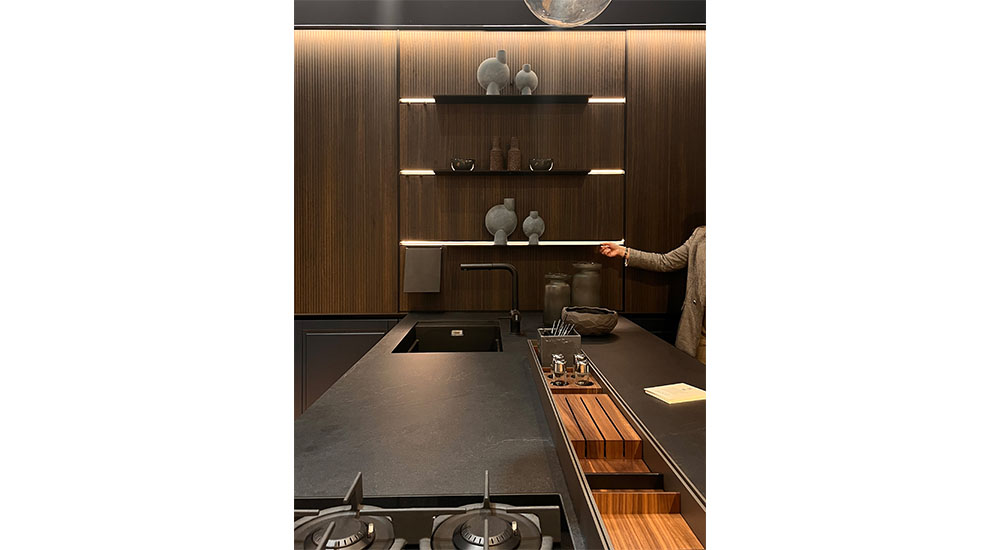
Photo: Agustina Ricci
The kitchen island has officially evolved. It is no longer a simple prototype of a table or a static block of cabinetry. Every island I saw this year at EuroCucina was a multi-functional center crafted to streamline everyday cooking. We are seeing unprecedented levels of utility embedded directly into the cabinetry. I am talking about clever drop-downs situated right in the middle of the island serving as hidden storage, and seamlessly integrated draining boards.

Additionally, central open shelving is being used to offer immediate access to culinary tools while acting as a curated display space, breaking up the monolithic feel of traditional islands. From a design perspective, the brilliance lies in engineering these complex, custom-looking features as modular, repeatable components. However, true design isn’t just about mass replication; it is about knowing how to read the space. The ultimate challenge is contextualizing these modular systems so they feel natively integrated into the unique architecture of each home.
2. Honest Materials: The Charm of Uniqueness vs. Engineered Predictability
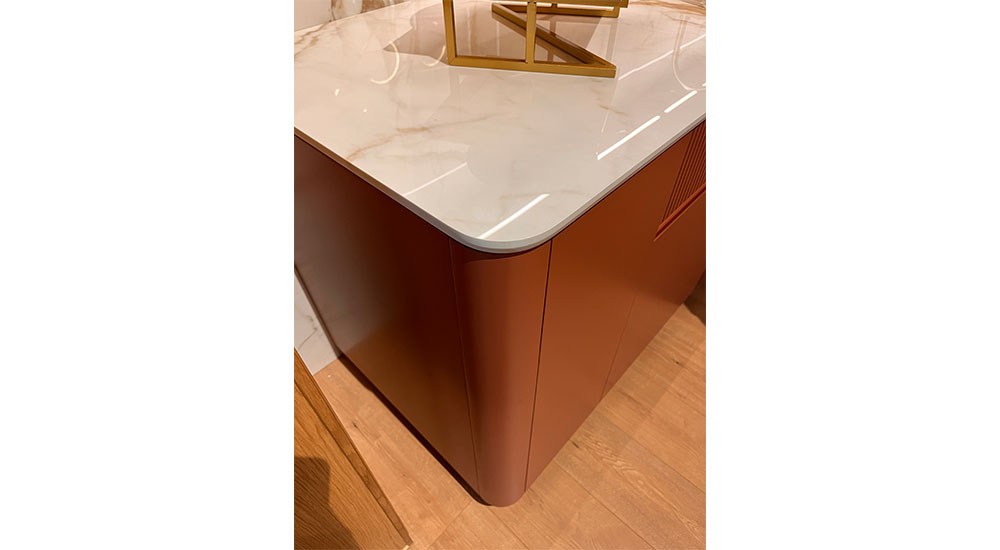
Photo: Agustina Ricci
Regarding materiality, we are finally stepping back from shy neutrals. We’re seeing full bold morphologies and vivid expressions. There is a deeply honest approach to how materials are being used, behaving more like pure nature: curves softening rigid lines, heavily veined stones, creatively textured panels and blocks of bright color.
This honesty is redefining how we talk about material variation. Take natural wood veneer, for example: while you can specify the type of cut (rift, tangential, etc.), you cannot dictate the exact tree it comes from. While some might view this as a lack of control or as a risk, I see it as the ultimate luxury. It means that every single kitchen and piece of millwork is an unrepeatable, one-of-a-kind design. The same organic charm applies to the unique veining of natural stones.
However, a successful scalable business must cater to different risk tolerances. For clients who prefer absolute predictability over organic variation, the industry is responding with incredibly sophisticated alternatives. Engineered surfaces like Dekton and pre-composed veneers such as Alpi allow us to deliver that striking European texture with zero surprises, ensuring that what the client sees in the render is exactly what arrives on-site. Ultimately, it’s about offering the choice between natural exclusivity and engineered perfection.
3. Lighting as a Main Character
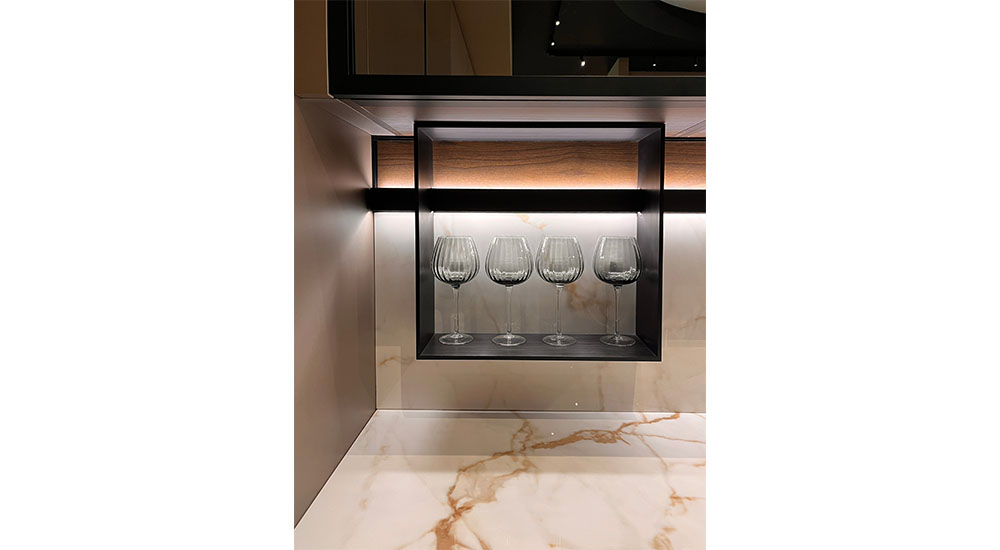
Photo: Agustina Ricci
Lighting in the kitchen is no longer just an afterthought or a detail; it is a main character. The approach to illumination has shifted from purely task-oriented to highly atmospheric and architectural. Light is now integrated everywhere: glowing from within glass cabinetry, illuminating each time you open a drawer or a door, highlighting the textured facades of islands, and serving as sculptural centerpieces to define the geometry of the space inside and out. For scalable cabinetry, the key takeaway is that lighting must now be treated as a manufactured component, engineered directly into the cabinetry at the factory level to simplify on-site installation.
The Takeaway from EuroCucina
EuroCucina 2026 proved that the future of kitchen design is bold, highly functional and uncompromising in its aesthetics. But at Corner Renovation, we know that a beautiful concept is only half the battle. Remodeling is an inherently stressful process, and when managing a project, the potential for a client to feel overwhelmed or lost is there.
This is where our true role lies. We are not just specifying cabinetry; we are translators. Our job is to take the high-end innovation of Milan and contextualize it for the US homeowner, acting as a trusted guide through every technical detail. Whether we are helping a client embrace the unrepeatable charm of natural wood or providing the safety of engineered predictability, the goal is the same: to make them feel accompanied every step of the way.
By systemizing our millwork and being radically honest about our materials, we don’t just deliver premium kitchens: we eliminate the friction of the remodeling journey.
—Agustina Ricci, Lead Design & Sales at Corner Renovation