A fireplace can bring literal and emotional warmth to any place in the home – kitchen, bathroom, living space and more. Designer Natalie Pullen offers her thoughts on the smartest ways to add this compelling element.
How do you determine the optimal placement and scale of a fireplace within a room to balance focal point impact with functional flow and furniture arrangement?
In every design project, form follows function for me. It’s most important to first grasp how the room or space will be used, what’s its purpose or intent, and how it wants to feel on any given day. The answers to those questions start to determine how all the bits of pieces of a room (fireplace, furnishings, artwork, lighting) all come together. Every space wants a degree of hierarchy and order – moments that indicate or encourage how the space should be used/what it can offer to people who walk inside it. Fireplaces offer dramatic opportunity to establish that order because they are such an emotional element; when they’re lit, they are function (heat) and form (an artistic natural element) in and of themselves.
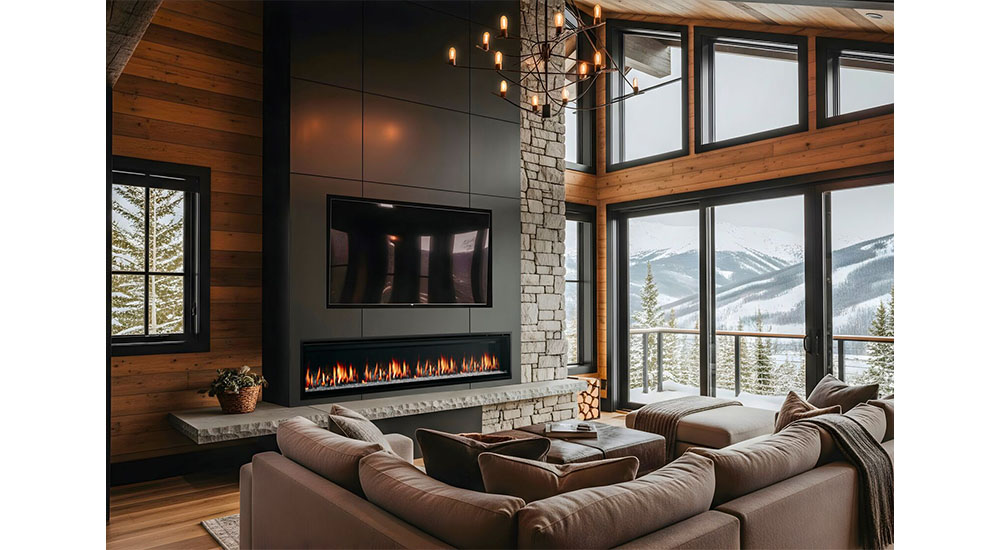
Above: The Allusion Edge Linear Electric Fireplace by Simplifire was a finalist in the IBS awards program at this year’s Design and Construction Week in Orlando. Photo: Hearth & Home Technologies

Scale is relational. The size of a fireplace unit is arbitrary until it’s in relationship with its room (ceiling height especially is very key), the color and texture of finishes of the room even start to affect the experiential interpretation of scale; whether or not the room has views to outdoors will play a part. A lot of design is about deeply looking at the conditions you’re working with and going with your gut on what “feels” right.
How do you approach fireplace design differently in open-concept versus traditional room layouts, particularly regarding sightlines and how the fireplace relates to multiple zones?
Traditional layouts are in some ways a bit easier because there are hundreds of years of design precedent to pull from; traditional layouts tend to lend themselves to more symmetry and order and classic proportion than an open concept space. Fireplaces are wonderful grounding elements in an open concept space that holds multiple functions or has a lot of overlap between visual and physical space – they establish a true backdrop or focal point. Open concepts provide an opportunity for play as well – units that are double- or multi-sided or have a unique (non-rectilinear) shape to them.
For ultra-luxury projects, which materials or finishes do you find create the most sophisticated impact, and how do you balance timeless elegance with current design trends?
Natural materials are always the most sophisticated and timeless in my book. Within natural elements trends can come and go, of course (species and stain of wood being the most notable), but regardless of color or trend their earthen-made nature makes them eternally grounding for us as human beings – they connect us more deeply to our interior spaces. For ultra-luxury projects, taking care to implement hand-made products and materials wherever possible (hand carved furniture, artisan-made hardware and lighting, hand formed or glazed wall tile, etc.). The time it takes to make those elements is evident in their look and value, I love to celebrate the artists who create them by pairing them with projects that can afford them.
There is nothing inherently wrong with design being trendy (we’re all products of the time in which we live); the mistake comes when you are implementing a trend for trend’s sake. When a home is no longer a true reflection of the people who live inside it, but has instead become a mass-produced, white-washed interpretation of what “everyone likes”, it’s lost its purpose. To escape this trap, I am constantly asking myself “why” when making design decisions for a client. If I don’t have a real answer to that question that is rooted in tangible things I know about my client, it’s the wrong design decision. Even if it’s trendy.
—Natalie Pullen designed the Hearth & Home Technologies exhibit at DCW 2026