
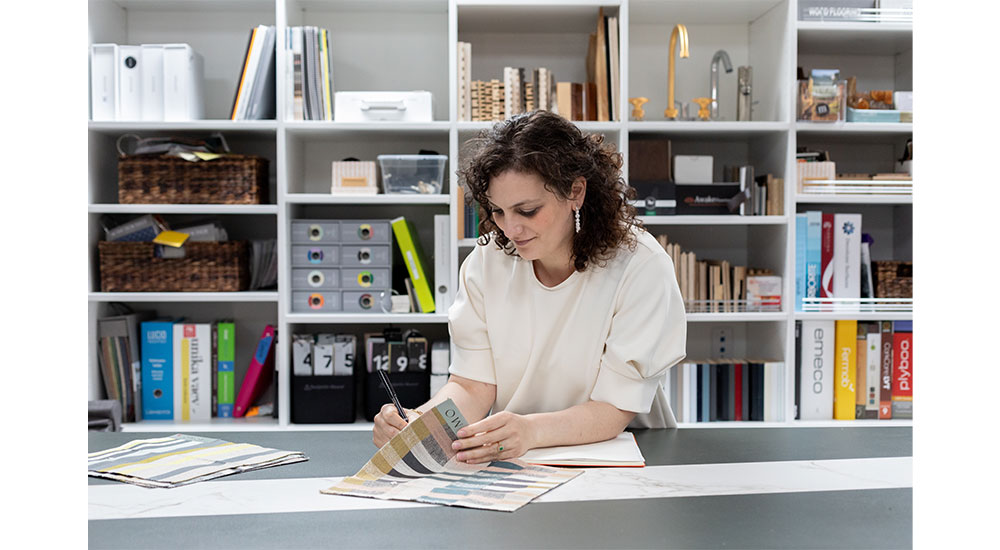
When a client tells me their kitchen feels overwhelming and cluttered, my first instinct is not to suggest more storage space, it’s to ask how they live and function in the space. As a designer with ADHD and likely dyslexia, I have spent enough time adapting to spaces that were not built for my brain to know that the problem is rarely the person and almost always the space.
Above photo: Rima Nasser, principal designer at TEW Design Studio, believes in design that works with her clients – not against. Photo credit: Allie Mullin Photography.
Neurodivergence encompasses a wide spectrum of cognitive styles, including ADHD, autism, sensory processing differences and dyslexia. Research estimates that roughly one in five people identify as neurodivergent. That means a significant portion of our clients are living in spaces that were designed for a neurological baseline that does not represent how they function. As designers, we can change that.
Shifting the Perspective
No two neurodivergent clients are alike, yet nearly all have spent years adapting themselves to their spaces rather than the other way around. The shift that we must consider as designers is not in what we specify but how we think before we get there. The clients who benefit most from this thinking will not always tell you they need it. Inclusive design, when done well, is simply good design.

The philosophical shift starts early in the discovery process. Asking “How do you move through the space on a hard day?” and “What in your current kitchen causes you the most frustration?” are design questions and not diagnostic questions. They help bring out answers that change everything from material selections to layout logic.
Starting in the Heart of the Home
The kitchen is where this philosophy gets tested most; it is a highly stimulating space that demands sequencing, memory and multitasking – often under the pressure of time. Cognitive load solutions indicate how much mental effort a space demands just to function in it. A kitchen where storage systems ask the user to make a series of small decisions every time they cook is a high cognitive overload environment.
Behavioral flow asks whether the space supports or fights the way a person moves through their day. Is the coffee station on the opposite wall from where the mugs are stored? Does the pantry have easy access while cooking?
Designers who serve these clients well are not necessarily specifying differently but instead thinking differently. I am always asking whether the workflow is intuitive versus interruptive, whether what the eye lands on helps or distracts and whether the storage system makes life simpler or just moves clutter around. Most clients will never know which question changed everything, and that is the point.
Bathroom Therapy
Sensory regulation is about how the environment affects our nervous system. For clients with sensory sensitivities, the bathroom can be a place of refuge or a daily source of dysregulation, depending on decisions made during the specification phase. A bathroom with nothing but hard surfaces and sound-reflective elements can feel aggressive rather than soothing.
The details that affect a sensitive nervous system are often the ones resolved last, like lighting or acoustical solutions. They are also the ones most likely to be selected by default rather than intention. When we make those decisions with a specific neurological profile in mind, the result is a space the nervous system can finally rest in.
Neurodivergent clients are not a niche market. They are sitting across from us in discovery calls, describing spaces that have quietly exhausted them for years, often without the language to explain why. I know that feeling from personal experience. I spent most of my life reorganizing, simplifying, starting over and wondering why things haven’t resonated with me. It was not until I understood my ADHD and likely dyslexia that I realized the spaces around me were working against me, not with me. That realization changed how I design for everyone. When design gets it right, it does not just improve the space, but it changes your clients’ lives and how they experience themselves in it.