

Homeowners today are more informed, more involved and more selective than ever before when it comes to kitchen and bath renovations. New data from the Home Improvement Research Institute’s (HIRI) biennial “Project Decision Study” highlights that while demand remains strong, the evolving way projects are planned, priced and executed is directly impacting design pros.
1. Kitchen and Bath Projects Are Discretionary
Not all home improvement projects are viewed the same. According to HIRI’s study, interior projects such as kitchen and bath renovations are largely discretionary and more choice-driven than exterior or mechanical work. For instance, 65% of homeowners report taking on a kitchen project to improve aesthetics while only 29% are motivated by repairs.
This means that, unlike a roof replacement or HVAC repair, kitchen remodels are rarely urgent. Instead, they are driven by lifestyle upgrades and personal preferences. Because of this, homeowners are more willing to explore options, compare ideas and invest in design details. However, they also take longer to secure direction and decide to start projects.
On top of being discretionary, kitchen and bath projects also represent the highest-value segment within interior remodeling. Among mid-to-large projects, kitchens average approximately $21,474 and baths $16,336, outpacing other interior categories.

For designers, this means the value proposition of hiring a pro goes beyond execution. Success hinges on the ability to provide inspiration and guidance and to help translate high-stakes vision into reality.
2. Designers Still Shape Outcomes
Today’s homeowners are not often passive participants. They lead project initiation and often make key decisions around materials and design direction.
At the same time, the HIRI study shows that professional design involvement increases significantly in interior and major renovation projects compared to other areas around the home. When tackling kitchen projects, 59% of homeowners hired a professional; a figure which increases to 72% for bath projects. Additionally, when designers were engaged, 81% of homeowners reported that the designer had a strong influence on final decisions.
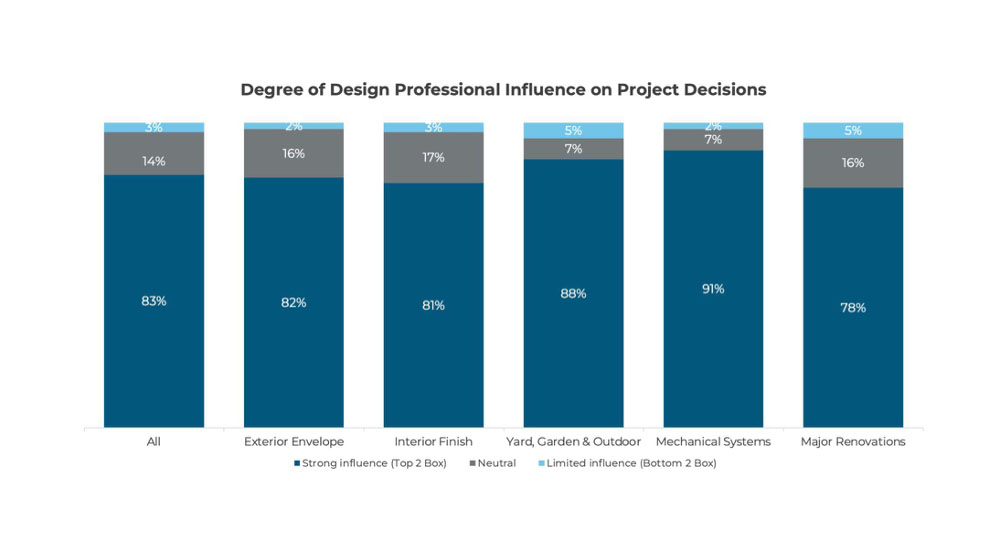
This creates a nuanced dynamic: homeowners may start the journey independently, but designers play a critical role in refining and elevating the outcome.
So where does the opportunity lie for kitchen and bath designers? It’s crucial to engage with homeowners in the average six-month period between project idea and decision to start – before key design choices are locked in.
3. Relationships Close the Deal
The path to a kitchen remodel often starts online. Homeowners rely heavily on digital sources such as social media and home improvement websites for ideas, especially for kitchen and bath projects.
However, when it comes time to hire a professional, referrals remain the dominant channel, with 48% of homeowners having found their pro through word of mouth. Digital plays a secondary role in this process, with 34% finding a contractor through online search engines and reviews.
This split highlights a key reality: discovery and decision-making happen in different ecosystems. Designers who invest in both a compelling digital presence and strong referral networks are better positioned to capture projects at every stage of the journey.
4. The Middle Bid Wins
Pricing strategy continues to be a critical factor in project selection. On average, homeowners receive 2-3 bids, and most move forward with the middle-priced option.
For design professionals, this reinforces the importance of positioning. Being the lowest bid can raise concerns about quality, while the highest bid risks pricing out the client.
Success often lies in clearly justifying value by demonstrating expertise, transparency and thoughtful design while staying within a competitive range.
5. Emotion Drives the Decision
While budgets and timelines matter, the motivations behind interior projects are deeply personal. Homeowners cite comfort, enjoyment and aesthetics as primary drivers for these projects.
In fact, satisfaction with interior projects tends to exceed expectations, suggesting that when done well, these renovations deliver meaningful lifestyle improvements.
For designers, this is an important storytelling opportunity. Remember that clients aren’t just upgrading cabinets or finishes. Rather, communicate that you understand the importance of investing in how their space feels and functions every day.
6. Timelines Require Active Management
Project timelines remain a persistent challenge, particularly as project complexity increases. For example, kitchen projects often involve multiple overlapping upgrades, with 39%-43% of kitchen remodels occurring alongside other interior improvements such as flooring or additional room updates. Additionally, the HIRI study finds larger renovations can extend significantly, with major projects averaging 67.5 weeks from concept to completion.
Delays are reported to be most commonly driven by scheduling conflicts, material availability and labor constraints. This puts added pressure on design professionals to set expectations early and communicate consistently throughout the process. Clear planning and proactive coordination can make the difference between a smooth experience and a frustrating one.
Designing for a More Engaged Homeowner
Homeowners may be more engaged and more empowered, but they still rely on professionals to bring cohesion and expertise to their projects.
The path forward is not about taking back control, it’s about meeting clients where they are. That means inspiring them early, guiding them strategically and delivering an experience that aligns with both their vision and their expectations. Those who can balance inspiration with execution will be best positioned to succeed.
—Dave King is executive director of the Home Improvement Research Institute (HIRI)