
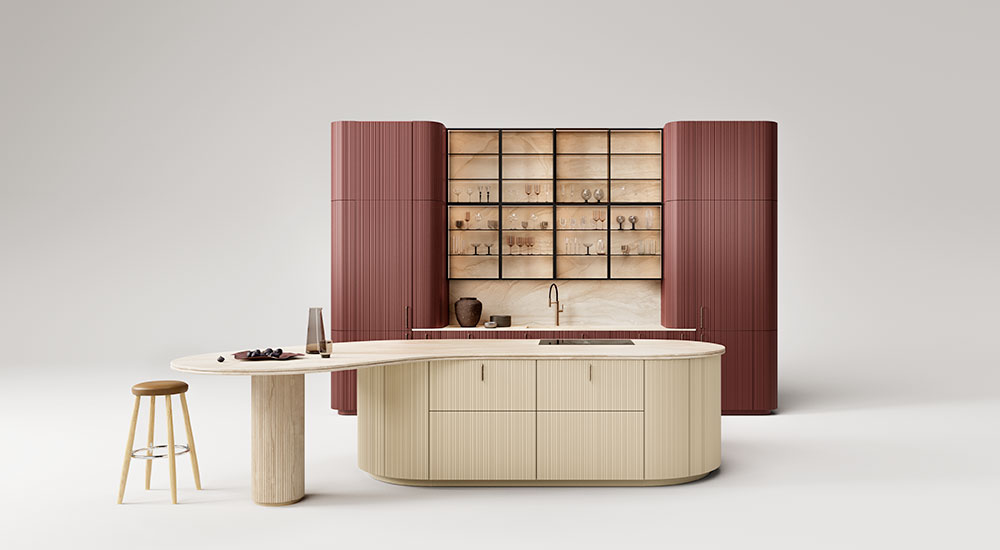
Cesar has unveiled an update to Tangram, the project designed by García Cumini in 2022 which, starting from a reflection on geometry and materiality, introduced a distinctive language into the contemporary kitchen landscape, interpreting the heart of the home as a welcoming, deeply convivial space.
This new iteration integrates an additional module into the system, expanding its compositional possibilities while reinforcing its visual coherence. A design evolution that moves beyond the perimeter of the island, extending its vocabulary to tall units, wall cabinets and wall-mounted base units.
With Tangram, surfaces become a field of research and are shaped through curves with variable radii, at times paired with fixed-radius curves, from which organic and unpredictable geometries emerge. This choice moves beyond the concept of a repeatable form to construct a system of combinable modules capable of generating ever-changing configurations. The result is a fluid, dynamic language in which each composition retains its own individuality while remaining instantly recognizable.
Behind the collection’s apparent formal simplicity lies a complex and rigorous development process, involving experimentation, prototyping and continuous testing. The construction of the curved doors, in particular, requires the bonding of multiple layers, meticulously calibrated to ensure long-term stability and durability. The project’s complexity is reflected in an in-depth study of materials and surfaces: each responds differently to the shaping process, making careful fine-tuning essential. This path has been developed in close synergy between designers, research and development, and the production chain, where expertise and sensibility converge to translate research into tangible quality.

Tangram is presented in a new configuration that highlights the dialogue between form and material through a carefully balanced interplay of volumes and colors. The tall units are finished in Anodyc Jaipur red lacquer with Groove doors, a sequence of vertically milled grooves with an irregular rhythm that softens the perception of junctions between modules, delivering a continuous overall image.
The hue, inspired by the layered chromatic tones of the architecture of the Indian city from which it takes its name, interacts with light to add depth and dynamism to the surfaces. The island in Seta Lacquer, topped with Breccia Sarda marble, creates a harmonious contrast with the vertical structure. The worktop introduces Palmier, a new edge profile that expands the existing range of finishes. Completing the composition are the Oi handles by García Cumini in a bronze finish.