
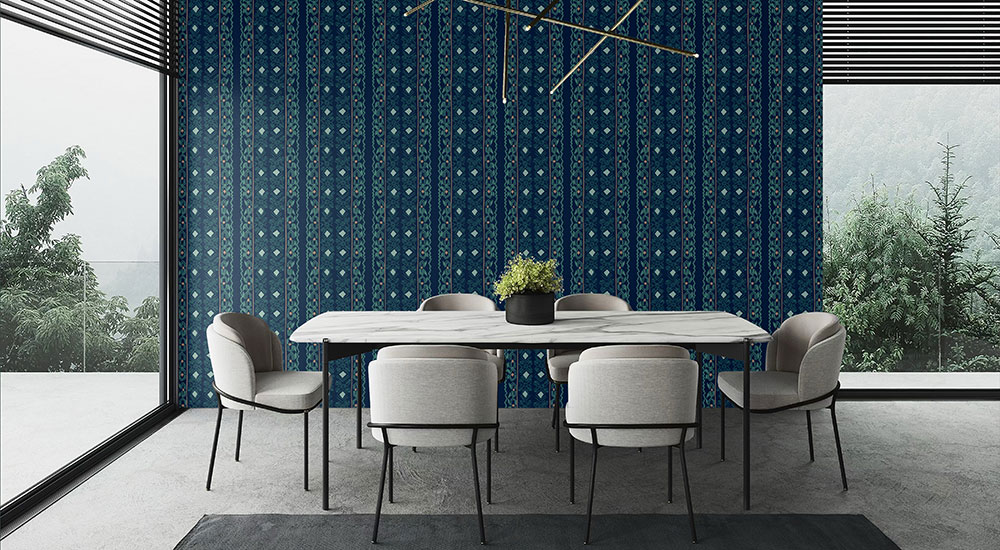
Anduba, a company partnering with Indigenous artists to create sustainable wallcoverings, has launched its debut collection, The Brave Ones. The collection features patterns created by Indigenous artists from Brazil, Mexico and the U.S., translated into designs that bring Indigenous art and perspectives into contemporary spaces.
Founded in 2025 by Flavia Pereira, Anduba addresses a persistent gap — Indigenous artists create work that carries distinct ways of seeing and relating to the world, yet that work rarely reaches the spaces where people live, work and gather. Not because the art doesn’t exist — but because there has been no scalable, ethical pathway to bring it there.
Anduba’s model makes this possible through a different approach to working with artists.
A Different Kind of Partnership

Unlike traditional licensing models where companies commission designs and pay artists a one-time fee, Anduba operates on a partnership model. Artists retain full copyright and earn royalties on every yard sold up to three times the industry standard. This creates ongoing, predictable income.
Every collaboration begins with a single question: What do you want to bring to the world through your art? Artists create original work based on what matters to them, then collaborate with Anduba to translate it into repeatable patterns suitable for architectural scale. The process takes a few months, working closely with artists on decisions about color, scale and rhythm.
Industry Recognition
Anduba is one of six founding participants in the Living Future Institute’s Declare Equity Pilot Program, selected alongside established industry leaders including Mohawk, Tarkett and Hightower.
As a small business working directly with Indigenous artists, Anduba is helping shape equity standards that are practical and centered on people.
The Brave Ones Collection
JayCee Beyale (Diné/Navajo Nation, U.S.) – Ganado Tapestry
The Ganado Tapestry pattern draws inspiration from traditional Navajo weaving techniques, reimagined through a contemporary lens. The pattern celebrates spider web designs and the connection between cultures worldwide. Each geometric element reflects Beyale’s belief that, like a well-woven rug, all elements of our world are interconnected — remove one thread, and the whole unravels.
Miguela Moura (Guarani People, Brazil) – Web of Life
Moura chose to paint Ñanduti, a weaving technique passed down through generations of women in her community. According to tradition, a spider taught the women how to weave the intricate pattern, but the real gift was the meaning embedded in it: the interconnection of all things, a web where every thread shapes what the whole becomes.
The collection also includes work from Waxamani Mehinako (Mehinako People, Brazil), Steven Yazzie (Diné/Navajo Nation, U.S.), and Cuauhtémoc Wetzka (Nahua People, Mexico).
Sustainable by Design
Production uses sustainable, healthier materials and is made-to-order to avoid waste. Commercial wallcoverings are printed on a substrate made from recycled plastic bottles — a typical 75-yard project repurposes approximately 650 plastic bottles — while residential options use FSC-certified materials. All wallcoverings are PVC-free and free of harmful chemicals.