
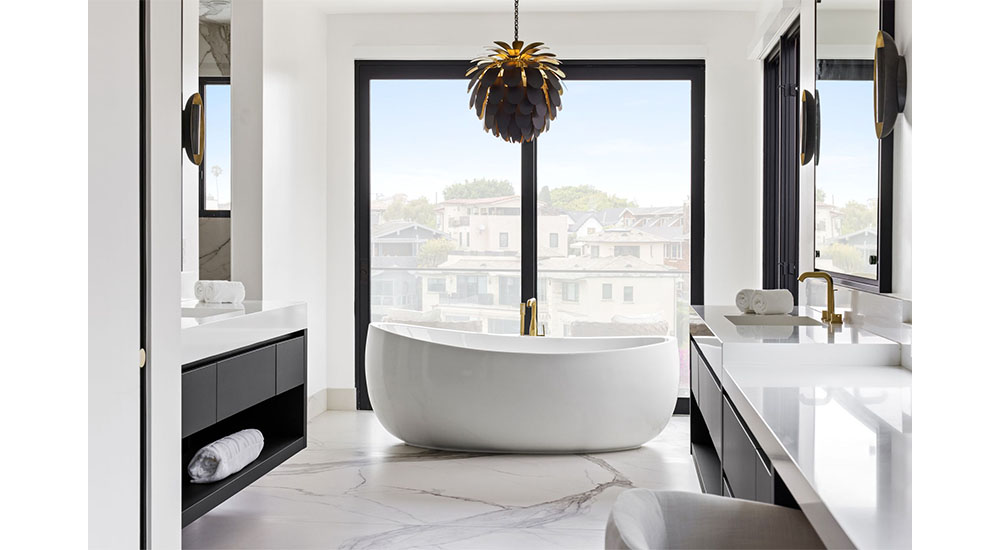
Luxury bathrooms have long faced a familiar tension: how to deliver spa-level hydrotherapy while maintaining a clean, visually cohesive space. Traditional freestanding tubs often required visible plumbing, access panels and mechanical components, forcing designers to choose between performance and aesthetics. For homeowners and architects alike, this trade-off has shaped decades of bath design, often limiting creativity and making the tub a functional centerpiece that could disrupt an otherwise calming environment.
Over time, the demands of residential wellness have intensified. Homeowners increasingly expect bathrooms to provide not only functional utility, but also emotional and physical restoration – a space where they can decompress, practice self-care and enjoy a spa-like experience without leaving the home. Trend reporting continues to show spa-like design dominating bathroom planning into 2025 and beyond, with wellness-driven features ranking high among both designers and clients. The modern bath is no longer an afterthought; it is a sanctuary.
In response, manufacturers are rethinking hydrotherapy from the inside out. Rather than allowing mechanical systems to dictate the form of the tub, newer designs fully integrate technical components within the bath’s structure. Jets, pumps, plumbing and controls are increasingly concealed, enabling uninterrupted silhouettes and far greater flexibility in how tubs are placed within a space. The result is what many designers now describe as “invisible design” – where performance exists without visual intrusion.
Invisible Design Explained
The technical challenges of concealment – like maintaining reliable water pressure, optimizing jet performance for therapeutic effect, and ensuring access for service – are being addressed with precision. Advanced engineering now allows for systems that deliver powerful hydrotherapy through discretely placed jets, pressure-balanced pumps and smart control interfaces that can be tucked away or seamlessly integrated into the bathroom’s architecture. Designers point to this evolution as a reason why hydrotherapy can now be both highly effective and visually minimal.

Architects and designers are prioritizing these concealed systems because they align with a broader philosophy of wellness-centered, minimalist design. Clean, uncluttered lines create a sense of calm that supports relaxation, while hidden systems allow designers to place tubs more flexibly and harmoniously within the room. This is particularly important as bathrooms increasingly become envisioned as personal sanctuaries rather than purely functional spaces. Design trend reports emphasize that wellness – including features like steam showers, deep soaking tubs and integrated hydrotherapy – remains a top priority in modern bathroom design.
Beyond aesthetics, concealed systems enhance the overall user experience. Homeowners benefit from intuitive operation, simplified maintenance access, and the seamless integration of hydrotherapy without the visual complexity of traditional components. Designers, in turn, gain greater freedom to explore custom layouts, integrated seating, and cohesive material palettes that would be difficult to achieve with conventional visible systems.
Looking ahead, the implications for spa-level residential bath design are significant. As technology becomes more compact and intelligent, concealed systems open new possibilities for experimentation in form, materials, and personalization. Integrated hydrotherapy may increasingly coexist with features such as chromotherapy lighting, aromatherapy delivery, ergonomic seating and app-enabled controls – bringing professional-grade wellness experiences into residential environments of all sizes.
Ultimately, the move toward invisible hydrotherapy represents a meaningful evolution in bath design. By addressing longstanding technical limitations while meeting the aesthetic priorities of today’s designers and homeowners, these systems are redefining what luxury baths can be. As the industry continues to prioritize wellness, efficiency and seamless integration, the future of the bathroom lies in technology that performs powerfully – while remaining almost entirely out of sight.
—Ashley Steinhardt, VP of sales, Hydro Systems