
We take a look at two brands whose innovations and values have significantly contributed to sustainability in the sector.
Hansgrohe Group
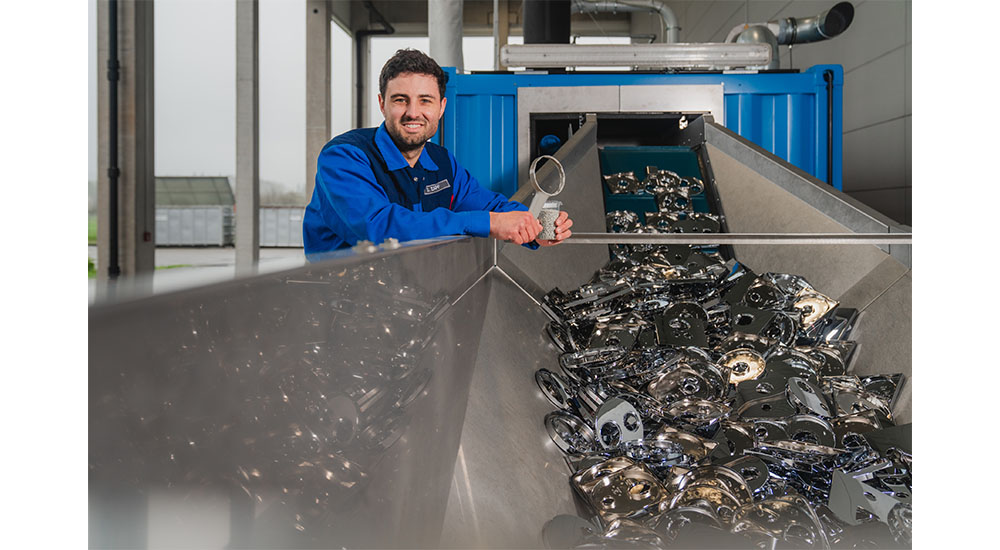
David Zapf, specialist for surface technology at Hansgrohe Group, shows off the breakthrough electrohydraulic technology at the heart of the brand’s recycling of galvanized plastic parts. Photo: Copyright Hansgrohe SE / RecTec
For plumbing manufacturers serious about recycling their products, galvanized parts have long posed significant challenges due to their complex material composition. Conventional methods typically focus solely on metals – not plastics – resulting in a low material purity that meant only downcycling of components was possible. This made the recycling process barely economically viable in relation to the value of recovered material.
David Zapf, specialist for surface technology at Hansgrohe Group, initiated a partnership with ImpulsTec that led to a revolutionary recycling procedure. The new process strips chrome-plated plastic components using a “shockwave” treatment and achieves a high degree of purity that makes both plastic and metals suitable for reuse in premium products.
The three-step process begins with shredding and screening the galvanized parts. Next, this mix is placed into a water bath where a brief blast of electricity triggers a reaction that separates the metal from the plastic material. (The used water is filtered and subsequently returned to the process in a closed loop.) Finally, magnets separate the plastic base from the metal coatings. Most of the recovered material – 70% to 80% – is plastic with stable purity, while the copper, nickel and chrome are sent to processing companies.

The program runs 250 days a year, eight hours a day and delivers up to 220,500 pounds of chrome-plated plastic annually. The upshot? Hansgrohe reuses 98% of its production waste materials. This marks a significant step towards circular economy goals, reducing resource extraction, energy and water use. The successful implementation of shockwave technology is not only a milestone for Hansgrohe but also offers promising prospects for other industries such as automotive and electronics.
Legrand
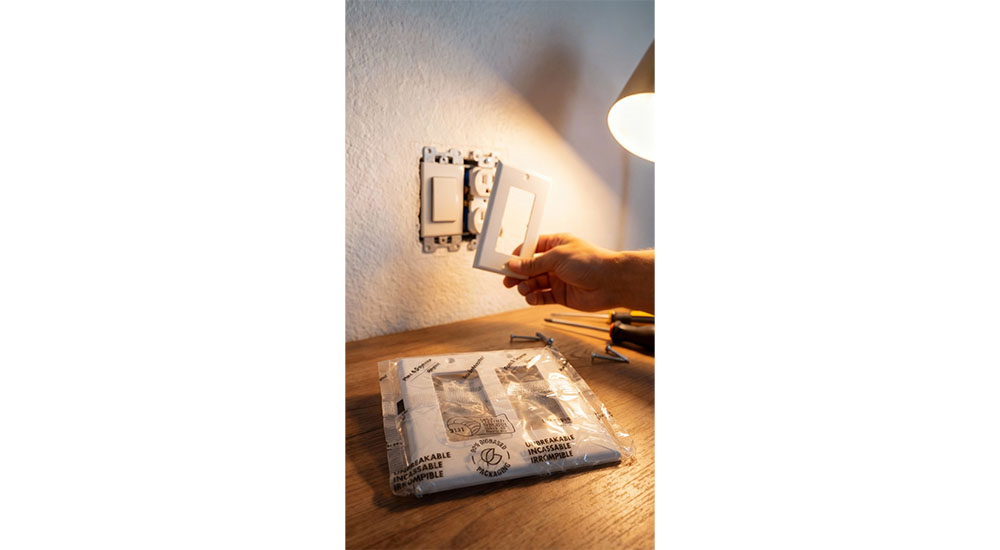
By adopting a compostable packaging material, Legrand looks to replace 117 tons of single-use, fossil-fuel-based plastic annually. Photo: Legrand
Earlier this year, Legrand achieved a major sustainability milestone with the transition of its wall plate packaging to compostable, bio-based materal, NatureFlex™. This is expected to replace 117 tons of single-use, fossil-fuel-based plastic annually, marking progress toward the company’s goal to eliminate 100% of single-use plastic from its packaging by 2030.
The 18-month initiative entailed more than 5,000 hours of engineering research, testing and material evaluation. Ultimately, Legrand selected NatureFlex, a Biodegradable Products Institute (BPI)-certified compostable packaging film that’s derived from renewable, responsibly sourced cellulose.
“This shift to NatureFlex packaging represents meaningful progress toward our environmental sustainability goals,” said Ratish Namboothiry, VP, Sustainability & Corporate Social Responsibility, Legrand, North & Central America. “Our teams worked tirelessly to re-engineer packaging that protects the product and reduces its impact on the environment.”
NatureFlex, produced by Futamura, offers the durability and protective performance required for retail environments, while providing a compostable, end-of-life pathway through industrial composting under appropriate conditions. Its USDA-certified, bio-based composition allows Legrand to replace traditional petroleum-based plastics without sacrificing functionality.
The transition applies to Legrand’s entire standard wall plate portfolio (excluding the adorne® Collection), offering immediate environmental benefits across one of the company’s highest-volume product lines.
“This project was far more than a packaging redesign, it was a complete rethinking of how we deliver our products responsibly,” said Racheal Rich, Pass & Seymour Sr. Product Manager, Legrand, North & Central America, who oversaw the material evaluation process. “Our goal is to lead the industry with solutions that reduce waste, protect resources and set new standards for sustainability.”
Legrand’s corporate social responsibility (CSR) strategy focuses on mitigating climate change, developing a circular economy, promoting inclusion, serving its customers and being a responsible business. Transitioning a high-volume product category to compostable packaging represents a meaningful step toward reducing the company’s environmental footprint.
The NatureFlex packaging will begin appearing in retail and distribution channels throughout 2026.