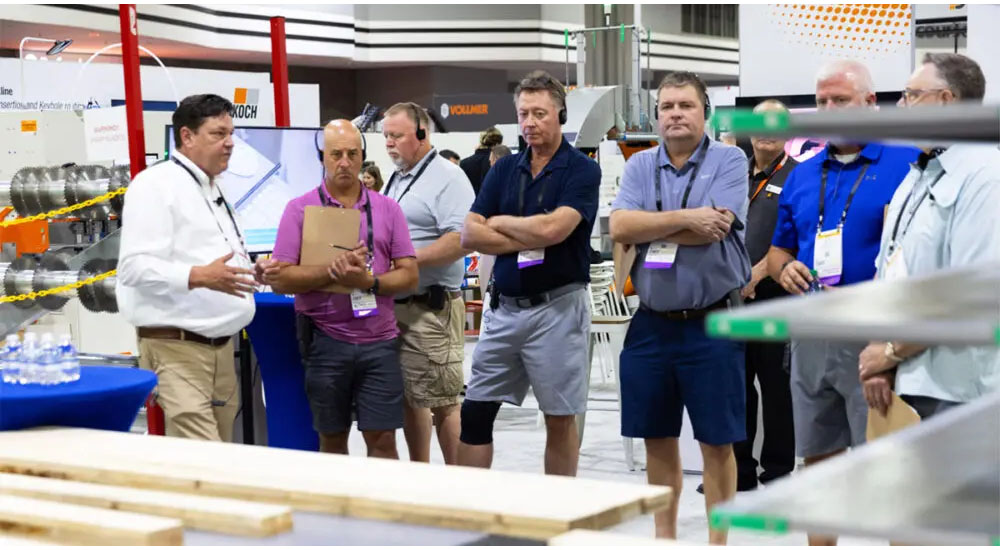
At IWF, there is no better way to understand where the woodworking and remodeling industries are going than to put on a comfortable pair of shoes and walk the floor.
That was my mission when I arrived in Atlanta for the International Woodworking Fair, held August 25 through 28 at the Georgia World Congress Center. IWF brings together woodworking professionals from across North America and around the world, with the latest machinery, materials, hardware, technology and design solutions all under one roof.
For me, the show started with what I call the “Power Walk.”
If you have ever attended IWF, you know what I mean. You can walk miles before lunch and still feel like you have only seen a fraction of the show. But the Power Walk isn’t just about getting your steps in. It is about seeing what is changing.

I was looking closely at the technologies and design ideas that will eventually make their way into American kitchens, closets and remodeling projects.
One of the biggest takeaways was how much influence European design continues to have on the American kitchen remodeling market. European manufacturers have been pushing the industry toward cleaner lines, better use of space, integrated storage and highly engineered hardware for years. Those ideas are no longer foreign to American consumers – they are becoming expectations.
Looking Beyond the Door
Today’s homeowner wants more than a pretty kitchen. They want the kitchen to work better.
That means deeper consideration of how cabinets are organized, how accessories are accessed, how drawers function and how every inch of space can be used. European design has been particularly influential in this area, with an emphasis on functionality without sacrificing appearance.
I see a continuing movement toward cleaner, more contemporary kitchens, fewer visual distractions and better integration of appliances and storage. Hardware is becoming more sophisticated, while cabinetry is becoming more streamlined.
The important lesson for American remodelers is that these aren’t simply European trends anymore. They are becoming part of the American remodeling conversation.
Sharing the European Perspective
I was also pleased to speak at IWF about European trends and what they mean for the American kitchen remodeling industry.
My message was simple: We don’t have to copy Europe, but we should pay attention to what European manufacturers and designers are doing well.
The European approach often starts with the question, “How can we make this space work better?” That philosophy can be extremely valuable in the American market.
Whether it is a clever drawer system, an integrated accessory, improved hardware or a more efficient cabinet layout, the goal is the same – give the customer more function in the same amount of space.
That is where I believe the next generation of kitchen remodeling is headed.
Technology Meets Craftsmanship
IWF also reinforced something I have believed throughout my career: technology doesn’t replace craftsmanship – it gives good craftsmen and manufacturers better tools.
The show featured innovations across machinery, cabinetry, architectural woodwork, software, tools, hardware and manufacturing. IWF describes the event as a place where woodworking professionals can see the latest technology while learning ways to improve efficiency and profitability.
Walking the floor, I kept coming back to one thought: the companies that succeed will be the ones that connect technology, design and installation.
A beautiful design that can’t be manufactured efficiently isn’t a great design. A cabinet that is manufactured perfectly but is difficult to install isn’t a great product. And the best technology in the world doesn’t help if the people using it don’t understand the customer.
The future requires all three.
The Power of the Show
For me, IWF wasn’t simply four days of machinery and exhibits. It was four days of conversations – with manufacturers, designers, suppliers, contractors and other woodworking professionals.
The Power Walk was the exercise. The conversations were the education.
Every aisle offered another idea worth taking home and thinking about.
After decades in this industry, I still enjoy seeing something new and asking, “How could we use that?” That’s what keeps this business exciting.
The woodworking industry is changing quickly. European design is influencing American kitchens. Automation is changing manufacturing. Hardware is becoming smarter. Customers are expecting more.
And if we keep walking, watching and learning, we have a pretty good chance of staying ahead of it.
That’s the real value of IWF.
—Eric Marshall MSD and Closet Training Guru is cofounder of the Closet Training Institute and a NKBA Global Connect Advisor