
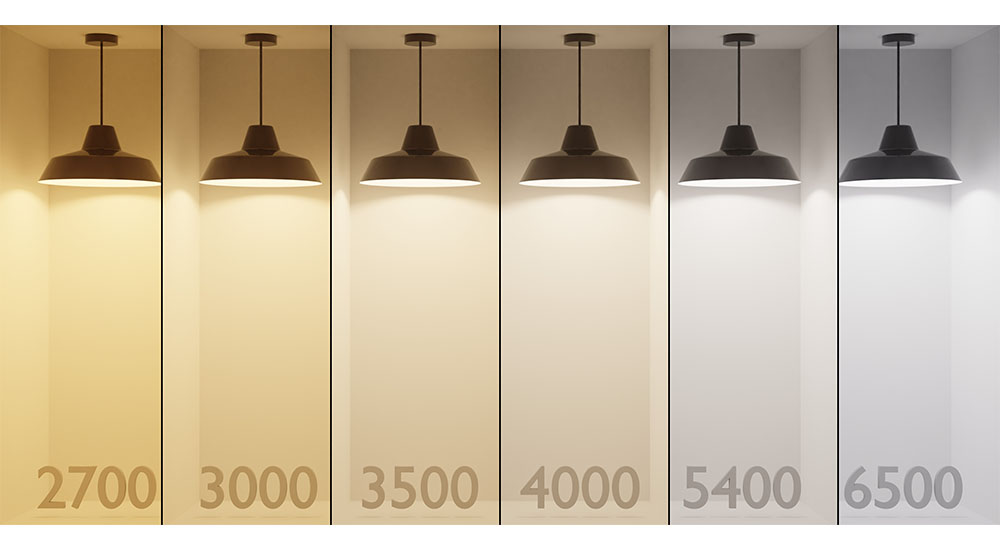
Understanding today’s technology can be difficult for homeowners and the trade as well. Technology as it pertains to lighting especially can be hard to grasp. Homeowners and special trades such as designers, architects and even electricians are asking questions of lighting consultants upon walking into a lighting showroom. What is integrated LED? What is Kelvin temperature? Why is LED wattage so low? Can LED be dimmed? These questions and more are normal conversation when a lighting consultant meets with clients.
What is LED?
Integrated LED simply means to have an LED (Light Emitting Diode) chip instead of a luminaire (light bulb) in a lighting fixture. This little chip can produce all types of wattages and Kelvin temperatures. The benefit of LED integrated light fixtures is that you can have thin profiles in surface mounted lights, smaller vanity lights, no-glare exterior lights, smaller recessed lights and track heads, but above all they are energy efficient, produce less heat and last a long time. An average LED bulb has a life expectancy of about 50,000 hours.
How do you convert LED wattage to regular incandescent?
As an average, (and it ranges from vendor to vendor), multiply the LED wattage by 8 to give you a rough idea of wattage. Example: An integrated LED light fixture states it is 12 watts; that times 8 equals 96. Therefore it provides almost as much light as a regular 100 watt light bulb. Consumers are more familiar with incandescent wattage and not LED wattage, so by converting it is easier for them to understand how much light a bulb will produce.
What is Kelvin temperature?
Kelvin refers to the temperature of color. Example: 2700 Kelvin is a warmer color while 3000 Kelvin is a whiter color. If you had a scale in front of you and it starts with 2400 Kelvin, and goes to 4000 Kelvin, then you are shifting from a warm yellow light to a high color shift of white light. The lower the Kelvin the warmer it is and the higher the Kelvin the whiter it is.

Kelvin affects the colors in a room. If your kitchen cabinets are white and you install recessed lights around the perimeter of the room, you want 3000 Kelvin which will make the cabinets show their true color. If you had installed 2700 Kelvin, those cabinets would appear cream in color. Kelvin is especially important for accenting artwork to make colors in the art pop. As a rule, 3000 Kelvin is commonly used in bathrooms and kitchens while 2700 Kelvin would be more common for bedrooms, halls, and living rooms. Lower Kelvin temperatures are also easier on the eyes compared to higher Kelvin temperatures that can be a bit more harsh on one’s eyes.
Is LED dimmable?
LED integrated fixtures as well as screw-in LED bulbs may be dimmed. It is best to use a dimmer that is LED compatible to prevent flickering and to be able to dim the fixture as low as possible. Most electricians always install LED dimmers when working on a job, as it is more common and practical now to use this kind of dimmer.
What does “lumens” mean?
Lumens refers to the amount of light that the fixture or bulb projects. It is important to understand that not all bulbs are equal, as they vary from vendor to vendor. As an example, one manufacturer that makes an 8 watt bulb and says it is equal to 60 watts and is a 2700 Kelvin and states their bulb is 600 lumens. Another manufacturer states the same thing about wattage and Kelvin, but says its bulb is 650 lumens. It is essential to review the information on the packaging when purchasing bulbs from different manufacturers. Installing bulbs with varying lumen outputs in the same fixture may result in noticeable differences in brightness. When replacing bulbs in recessed or track fixtures, lamps, or overhead lights with multiple sockets, it is essential to ensure that wattage, lumens, and kelvin ratings are consistent. Maintaining uniformity by selecting bulbs from the same manufacturer is strongly recommended.
—Carla Snowdon, CLC is a Certified Lighting Consultant accredited by the American Lighting Association and owner of Tidewater Lighting & Design in Old Saybrook, Conn.