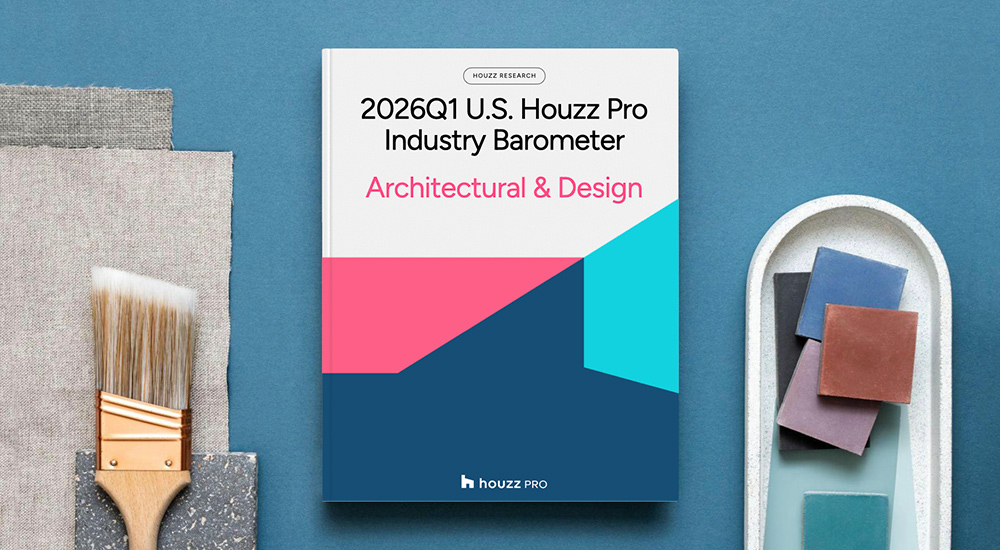
Houzz Inc. has released the Q1 2026 U.S. Houzz Pro Industry Barometer. The findings show that a moderately positive outlook outweighs negative expectations for 2026 in the construction sector, where 56% anticipate a good to very good year, 28% expect business conditions to remain stable and 16% anticipate weaker performance than last year. Sentiment among the design services sector (hereafter referred to as “design”) is more mixed, with half (50%) expecting a good to very good year, 35% reporting a neutral outlook, and the remaining 15% anticipating poorer business performance in 2026 versus 2025.
Looking at Q1, expectations are more subdued in the construction sector (55), following a 4-point decline in Q4 business activity (51) compared with Q3 2025. In contrast, design firms are more optimistic (61) as they closed out the year on a stronger note, with an 11-point increase in business activity (54) versus Q3 2025 (43), as more architects and designers reported gains in recent activity compared to those reporting declines.
“Construction and design businesses are heading into 2026 with a measured but resilient outlook,” said Marine Sargsyan, head of economic research at Houzz. “While expectations for the broader national economy remain subdued and cost and labor pressures persist, many firms anticipate stable demand for their projects. To drive revenue growth in 2026, businesses are adjusting their strategies by raising prices, prioritizing larger and higher-value projects, and investing in employee productivity, reflecting broader industry interest around AI-enabled software tools such as Houzz Pro.”
2026 Outlook
Houzz asked construction and design pros about their outlook for 2026 and expectations across various market conditions. In addition to the overall moderate business outlook for the year mentioned above, expectations for 2026 include:

- Improving demand: Nearly two-thirds of design firms expect improved demand in 2026 (62%), compared with 57% of construction firms.
- Mixed economic expectations: More businesses expect local economic conditions to strengthen (38% construction, 43% design) than worsen (29% construction, 26% design), while a larger share of pros anticipate the national economy will slow (43% construction, 51% design) rather than improve (30% construction, 32% design).
- Ongoing labor constraints: More than one-third of construction firms and nearly one-third of design firms expect labor shortages to persist (36% and 30%, respectively).
- Rising costs: A majority of businesses expect product and material costs to increase (69% construction, 65% design).
- Top strategies to achieve revenue growth in 2026:
- Pursue larger-budget projects (71%, construction, 64% design)
- Increase markup or margin (45% construction, 50% design)
- Improve employee productivity (32% construction, 30% design)
Near-term expectations are more varied across the construction and design sectors as businesses enter Q1 2026.
Q1 2026 Architectural and Design Services Sector Barometer
- The Expected Business Activity Indicator related to project inquiries and new committed projects increased to 61 for Q1 2026 (up 2 points from Q4) for the design sector. This is driven by a 4-point increase in expectations for project inquiries, while expectations for new committed projects remained steady at 60 points. Expectations for Q1 inched up to 61 for architects and remained at 61 for interior designers.
- The Project Backlog Indicator dropped significantly to 4.5 weeks in the beginning of Q1, 2.8 weeks shorter than a year ago. This was driven by the backlog for architects which dropped by half to 4.5 weeks, a decrease of 4.3 weeks. Meanwhile, interior designers were consistent year over year, reporting a 4.5 week backlog, down just 0.1 week from the same time last year.
- The Recent Business Activity Indicator related to project inquiries and new committed projects jumped to 54 in Q4 (versus 43 in Q3). This is driven by increases in both project inquiries (54) and new committed projects (53) in Q4 (up 11 points, each). Architects reported the largest improvement in recent business activity, with the indicator reaching 55 (up 16 points), followed by interior designers (50, up 2 points).
Q1 2026 Construction Sector Barometer
- The Expected Business Activity Indicator for construction businesses related to project inquiries and new committed projects declined by 11 points to 55 for Q1 (from 66 for Q4 2025). This is largely driven by double digit declines in expectations for project inquiries to 57 and new committed projects to 53 (down 10 points and 11 points from Q4 2025, respectively). Similarly, while both build-only remodelers and design-build firms anticipate improved Q1 business activity compared to Q4, with the indicator at 55 and 56, respectively, the expected business activity indicators are down 10 points, each.
- Overall, the Project Backlog Indicator remains largely consistent with last year’s level at the same time: 6.1 weeks in the beginning of Q1, up 0.3 weeks from a year ago. Build-only remodelers report a 5.5 week backlog (up 0.5 weeks), while design-build remodelers report a 6.6 week backlog (down 0.1 weeks).
- The Recent Business Activity Indicator related to project inquiries and new committed projects declined to 51 in Q4 (from 55 in Q3). This is driven by a 13-point decrease in project inquiries to 49 in Q4, relative to the previous quarter. In contrast, new committed projects increased by 3 points, reaching 52 points. While more businesses reported improvements in committed projects, a larger share of them cited a slowdown in Q4 project inquiries. The recent business indicator increased to 59 for build-only remodelers and declined to 43 for design-build remodelers in Q4.
The quarterly U.S. Houzz Pro Industry Barometer provides timely insights into the residential construction and design industry, including expectations, project backlogs and recent activity among businesses in the U.S. construction and architectural and design services sectors. Scores for each component are computed as a seasonally adjusted diffusion indices on a scale of 0 to 100, with index values over 50 indicating that a greater proportion of firms reported quarter-over-quarter increases than those reporting decreases. Detailed methodology and underlying quarterly indices for the construction sector and the architectural and design services sector, and other information on market conditions, can be found on houzz.com/research. The Q4 2025 Barometer was fielded December 2nd through December 22nd, 2025 and garnered responses from over 1,100 home improvement firms on Houzz. n=1,174.
If an indicator is above the 50-point line, more businesses reported an increase in expected or recent business activity compared to the previous quarter than those reporting decreases.