
Products and processes with sustainability at their heart underscore these brands’ commitment to cleaner, healthier environments
Caesarstone
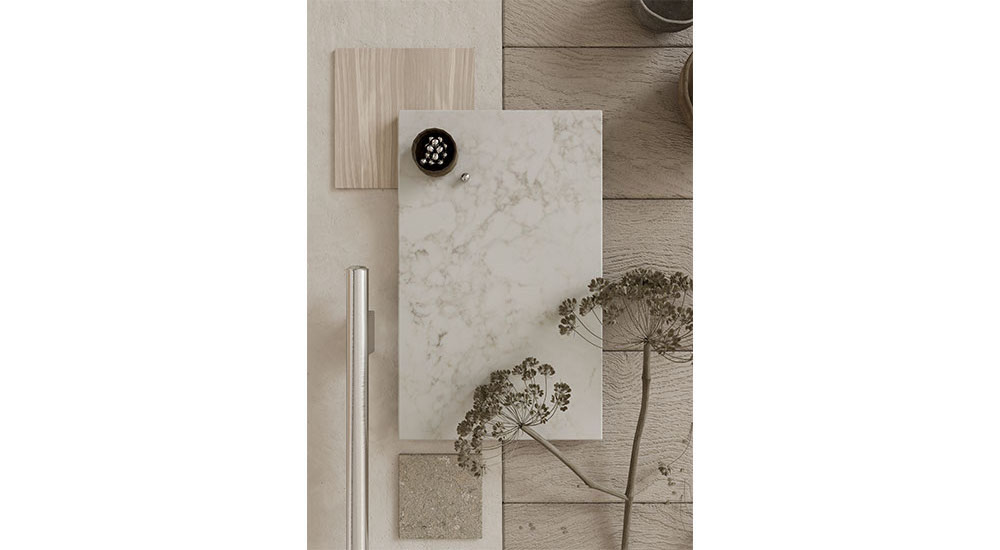
Calacatta Lacebound is a crystalline-silica-free surfacing from the Caesarstone ICON Collection. Photo: Caesarstone
Earlier this year, Caesarstone introduced a new surfacing specifically designed to address the health risks to fabricators and stoneworkers posed by the presence of crystalline silica in slab materials.
The advanced fusion surface, called Caesarstone ICON, is composed of approximately 80% recycled material and is free of crystalline silica.
In addition to health and safety solutions, ICON also offers some eye-catching aesthetic properties. Inspired by opalescent stones, the polished surfaces of the slabs amplify the interaction with light, generating visual depth and dimension.

“Caesarstone ICON is more than just a new product line – it represents the culmination of decades of innovation in both design and sustainability,” said Erik Christensen, president of Caesarstone US. “From our early days as one of the pioneers in quartz surfaces to now leading the way with crystalline silica-free technology, we’ve continually evolved to exceed the needs of our customers and the industry. This is the next step in that journey, giving fabricators peace of mind while offering consumers a product that is as sustainable as it is stunning.”
The advancements embodied by the ICON product are going to be phased into the brand’s current quartz portfolio.
With its November ESG report, Caesarstone has made progress on several fronts in its environmental performance. Its production sites have transitioned from liquid propane to natural gas, are utilizing 100% recycled water, have replaced diesel forklifts with electric models and one facility has achieved zero-landfill status.
EGGER
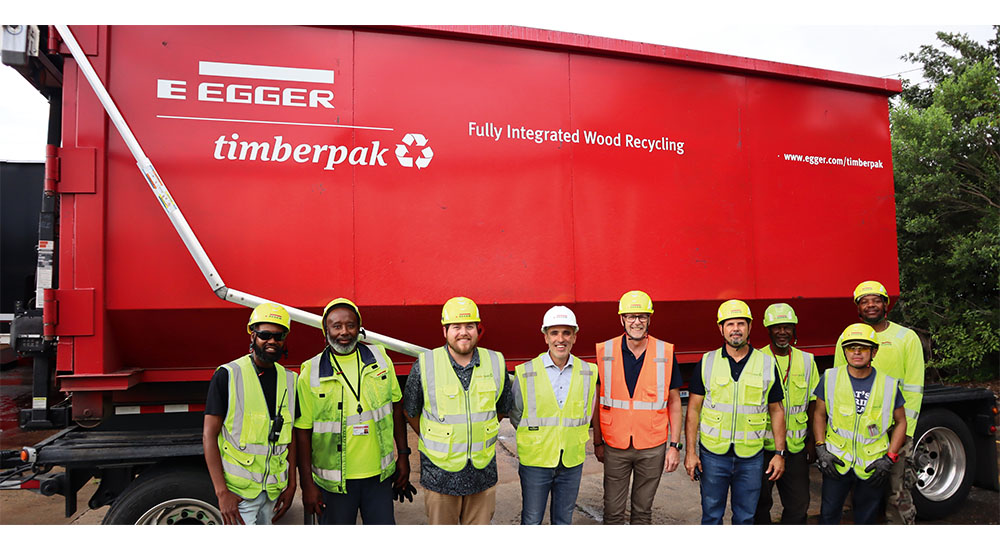
More than 70% percent of all EGGER Group products are recyclable after use and can be reintroduced into the material cycle. Photo: EGGER Group
A global presence in wood-based materials and products, EGGER Group has created a solid circular sustainability process. A central component of this is its Timberpak recycling collection sites, located in the US, UK, Germany, Austria, France, Poland, Romania and Italy. At these locations, wood for recycling from the region is collected, sorted and pre-shredded for transport to the local EGGER plants, where final processing takes place. Following this model, the firm has also been able to contribute to the development of suitable infrastructure in countries where the recycling of wood was not yet common.
Overall, the aim is always to manufacture high-quality products with the smallest possible product carbon footprint. To this end, EGGER not only focuses on sustainability through the use of recycled wood, but also through local production, which reduces long and costly transport routes and contributes to the overall ecological footprint. But the lifespan of the wood also plays a role; the longer the wood stays in circulation, the longer the carbon stays sequestered within it. Only at the very end of its life cycle, when the particles become too small for material utilization, can wood products be incinerated – and then they provide renewable energy.
Shannon Baker, chief technical officer at EGGER North America, said, “At EGGER, sustainability is at the core of our business model, not a box to be checked. We’ve built our processes around closing the loop – recycling wood wherever possible to give materials a second life and reduce waste. This approach allows us to protect valuable resources while offering products that designers and specifiers can trust to align with their own sustainability goals. For us, leading in design innovation goes hand in hand with leading in environmental responsibility.”